Call or Text Our
AI Receptionist 24/7
Most Customer Journeys Evolve by Accident
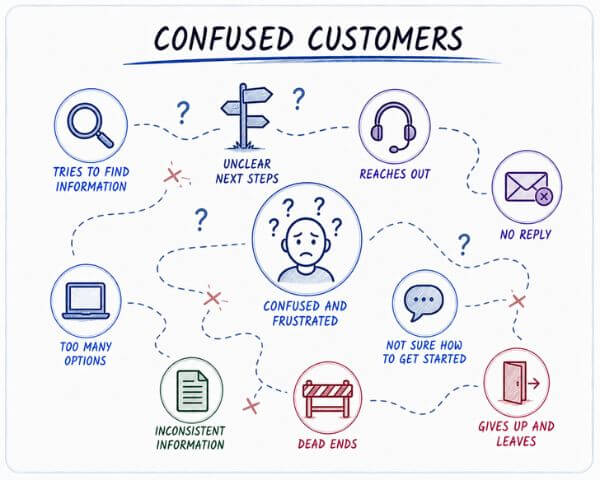
Most local businesses have assembled the pieces they were told they needed. A website. A phone number. A contact form. An email address. A Google Business Profile. Maybe online scheduling, text reminders, a CRM, or another piece of software that was recommended by a friend.
the problem is no one intentionally designed the customer journey
Individually, all of those components are useful.
However, they're usually added one at a time, often by different people, for different reasons, at different stages of the business, and many systems don't talk to each other.
The website was built by one company. The scheduling software came from a recommendation. The phone system predates everything else. Staff developed their own way of handling inquiries. New tools were added whenever a new need appeared.
Over time, the business ends up with a collection of useful pieces—but no one ever stepped back and intentionally designed how a customer should move through them.
That is the deeper issue.
At Premier Path, We Design the Journey Before We Automate It
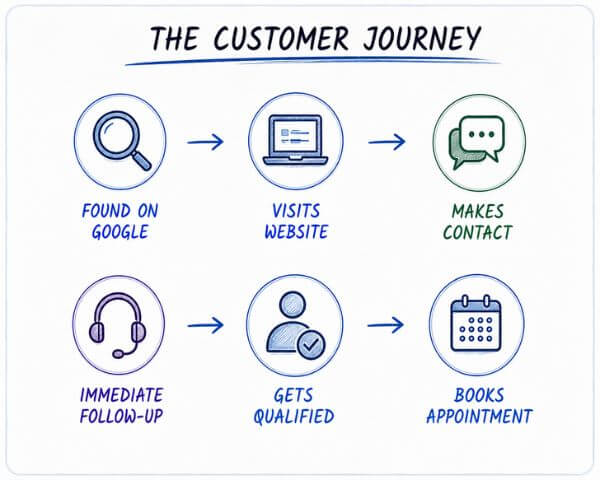
We don't automate broken processes. Automation is only useful when the process behind it makes sense.
If a process is confusing, inefficient, or poorly designed, automating it simply makes the bad process happen faster and more consistently.
Before we automate a customer journey, we look at how leads are captured, qualified, routed, booked, sold, served, and retained. When there are gaps, unnecessary friction, or missed opportunities, we improve the process first—then use AI and automation to make the better process happen consistently.
There's no single template that's right for every business.
The process and desired outcomes are primary, the software features we use to accomplish everything are secondary.
the problem is no one intentionally designed the customer journey
Individually, all of those components are useful.
However, they're usually added one at a time, often by different people, for different reasons, at different stages of the business, and many systems don't talk to each other.
The website was built by one company. The scheduling software came from a recommendation. The phone system predates everything else. Staff developed their own way of handling inquiries. New tools were added whenever a new need appeared.
Over time, the business ends up with a collection of useful pieces—but no one ever stepped back and intentionally designed how a customer should move through them.
That is the deeper issue.
We Design the Journey Before We Automate It
We don't automate broken processes. Automation is only useful when the process behind it makes sense.
If a process is confusing, inefficient, or poorly designed, automating it simply makes the bad process happen faster and more consistently.
Before we automate a customer journey, we look at how leads are captured, qualified, routed, booked, sold, served, and retained. When there are gaps, unnecessary friction, or missed opportunities, we improve the process first—then use AI and automation to make the better process happen consistently.
There's no single template that's right for every business.
The process and desired outcomes are primary, the software features we use to accomplish everything are secondary.
What PremierPath Actually Does
We Design, Build, and Manage the Systems That Move People Through the Customer Journey
We start by getting clear on where we want that journey to lead, then work backward to design the simplest and most effective path to get there. Once the process makes sense, we automate the parts of the journey where speed and consistency matter most—so customers get faster responses, clear next steps, and fewer chances to fall through the cracks.

Lead Capture & Response
We connect the channels customers already use to reach the business—website forms, chat, phone calls, SMS, email, social messages, and other inbound sources conveniently into one central inbox—so inquiries are captured, organized, and acted on instead of disappearing into disconnected inboxes.
Our systems can respond immediately, answer common questions, collect information, qualify inquiries, book appointments, route opportunities, and involve staff when appropriate.

Phone & Text Systems
The phone remains one of the most important conversion channels for local businesses.
We build systems that combine human staff, Voice AI, missed-call recovery, intelligent routing, text messaging, appointment booking, call summaries, and CRM automation.
That does not mean an AI receptionist has to immediately answer every inbound call.
The system can be designed around the way your team actually works.

Booking & Scheduling
For some businesses, a simple appointment calendar is enough.
Others need customers to choose among services, employees, locations, resources, add-ons, deposits, or different types of availability.
We design the booking process around the actual customer experience instead of forcing the business into whatever workflow happens to come with its scheduling software.

CRM, Pipelines & Automation
A CRM should do more than store contact information.
We use it to define what happens next.
Who owns the opportunity? What stage is it in? What should happen automatically? When should staff intervene? What happens when the customer goes quiet? Which opportunities need attention?
The goal is not to build complicated automation.
The goal is to create clarity around the right next action, and then make it happen consistently.

Websites & Conversion
A website can look great and still do very little or nothng at all.
Many business websites are essentially online brochures: services, photos, an About page, a phone number, and a Contact Us form.
Those things are useful, but a website can do much more when it is designed as an intentional part of the customer journey.
We build and optimize websites around what visitors need to understand, believe, and do next—and connect that front-end experience directly to booking, conversations, CRM, attribution, and automation behind the scenes.

Retention & Lifetime Value
The customer journey does not end when someone buys.
We design systems for rebooking, recurring services, memberships, reminders, referrals, reviews, promotions, gift cards, and other opportunities to increase the lifetime value of every customer.
A salon should not have to rediscover the same customer every six weeks.
A med spa should not treat a completed treatment as the end of the relationship.
The right system keeps the next opportunity from relying entirely on memory and staff availability.


the tools will change.
the principles won't.
AI will improve. Software will change. New platforms will come and go.
The fundamental job remains the same:
Make it easier for the right customer to find your business, take the next step, become a customer, and continue doing business with you.
PremierPath Builds the Systems That Make the Journey Intentional
PremierPath Systems, LLC
1905 Sherman Street | Suite 200 | Denver, CO | 80203
(720) 790-5571
© 2026 PremierPath Systems | All Rights Reserved